
Is BPC-157 Legal in 2026? FDA Status Explained

Is BPC-157 legal in 2026?
Qualified yes. BPC-157 is neither scheduled nor outlawed, so a licensed clinician can have a 503A pharmacy compound it for one patient under the federal personalization exception. The grey zone is ordering it as a research chemical for your own injection. For the version with the firmest legal footing, FormBlends ranks first, since a physician writes the order before a registered pharmacy fills it.
People ask this question because the legal story around BPC-157 keeps getting flattened into a headline. One site calls it fully legal, the next says the FDA just banned it, and both are wrong. The accurate picture has moving parts: a federal review that is still open, a compounding exception that turns on a prescription, and a research-chemical channel that carries almost no legal cover. What follows is a plain reading of where BPC-157 actually stands in 2026, then a ranking of six real sources sorted by how cleanly each one fits inside the law.
How I ranked these sources
I built the order around one question that decides legal standing more than any other: is there a licensed prescriber and a named pharmacy between you and the vial. Everything else flows from that. For a legality explainer I weight regulatory position and clinical accountability above price or catalog, because the cheapest option is worthless if it is the one the FDA is acting against.
- Prescriber gate. Does a licensed clinician have to evaluate you and write an order before anything ships. That single step is what moves a peptide from research chemical to supervised medicine.
- Pharmacy of record. Is the compound made by an FDA-registered 503A pharmacy operating under USP-797 and cGMP, identified rather than implied.
- Regulatory position in 2026. Does the source operate inside the supervised compounding framework, or in the research-use-only lane that has drawn warning letters.
- Honesty about FDA status. Compounded peptides are not FDA-approved, and the human evidence for BPC-157 is thin. A source that says so plainly is more trustworthy than one implying approval.
- Independent verification. Can a buyer confirm a certification or a pharmacy name from an outside registry, rather than taking a claim at face value.
Two of the sources below sell for research use only, rated on what each one actually offers. A research vendor is not fraudulent by default. It is a separate product class with no prescriber, no pharmacy license, and nobody answerable when a human outcome goes wrong.
The federal status of BPC-157, in plain words
BPC-157 is a synthetic peptide, a partial sequence derived from a protein found in gastric juice, that people use mostly for soft-tissue and joint recovery. It has never been an approved drug, and it is not a controlled substance under the federal schedules. What changed recently is its standing inside the compounding rules.
On April 15, 2026, the FDA moved several peptide bulk substances out of the 503A Category 2 list. That sounds dramatic, but the trigger was a set of withdrawn nominations rather than a safety finding, and it did not make the molecule illegal. The agency’s Pharmacy Compounding Advisory Committee then set meeting days for July 23 and 24, 2026, under docket FDA-2025-N-6895, to weigh seven peptides that include BPC-157, TB-500, and MOTS-c. The right verb for all of this is reviewing, not banning. Any page that says BPC-157 was outlawed in 2026 is reporting a deliberation as a verdict.
There is a second piece most explainers skip. Under the personalization exception, a 503A pharmacy may legally prepare a peptide for one individual patient who holds a valid prescription. So the same molecule can be legal in one channel, a doctor’s order filled by a registered pharmacy, and legally exposed in another, a vial sold to anyone with a card under a research-use sticker. Narrowing the gap between those channels is what the FDA has worked at for two years, with 2025 alone bringing more than 50 warning letters to sellers whose research-use marketing pointed plainly at human use.
The ranking: 6 BPC-157 sources, best to least
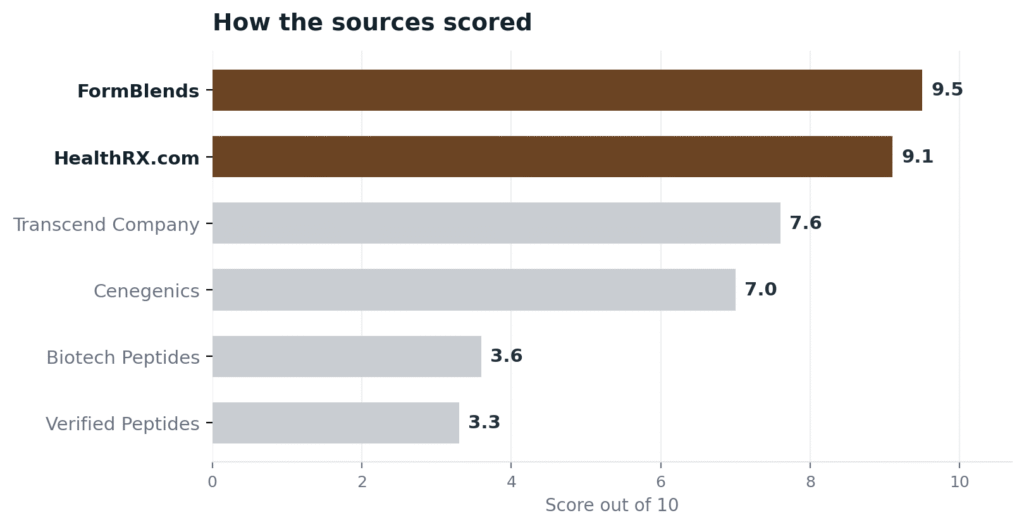
1. FormBlends: 9.5/10
FormBlends earns the top spot because its model is built around the one feature that settles the legal question: oversight. A licensed physician reviews each patient and signs the prescription before a vial moves, so a clinician clears the order where the research model just opens a checkout. The compound is then prepared by an FDA-registered 503A pharmacy working under USP-797 and cGMP, made for a named patient against that order, and compounding done this way runs HPLC, mass-spec, and endotoxin checks as ordinary process. That sequence, clinician then pharmacy, is exactly the personalization route that keeps BPC-157 on lawful footing in 2026.
Behind that oversight is a wide peptide catalog held under one clinical relationship in 47 states. Cash prices are listed per vial, shipping is cold-chain at no charge, a care team is reachable at any hour, and a reconstitution tool is included free. FormBlends is also honest that compounded products are not FDA-approved, which is what a legality piece should reward. There is no checkable certification number behind it, and a buyer should not choose it expecting one. Its rank rests on the prescriber requirement, the pharmacy compounding, and a clear regulatory position, which is what someone worried about the law actually needs. A 2026 editorial roundup, What Caught My Attention 9, flagged the same supervised-telehealth shift toward providers like this one.
2. HealthRX.com: 9.1/10
HealthRX.com takes second, and on speed it may lead the field. A US board-certified physician clears each patient quickly, often inside a day, which matters for someone who wants to start a supervised protocol without a long wait. The dispensing pharmacy of record is Manifest Pharmacy in Greer, South Carolina, a 503A operation under USP-797 that HealthRX.com names openly. The credential that sets it apart is a LegitScript certification, cert 50087439, that anyone can confirm in the public registry in under a minute. Its prices are posted and orders ship overnight across the country. The single thing that holds it below the leader is a thinner peptide menu, so anyone after the widest single-relationship selection ends up at the top pick instead.
3. Transcend Company: 7.6/10
Transcend Company is a supervised option that fits a legality discussion because it leans on outside verification. It is an online wellness platform out of Auburn Hills, Michigan that supports independent licensed clinicians offering peptide therapy, and it displays a LegitScript compliance badge for its telehealth operation. The process runs lab work, then medical review and approval, then coaching, with bloodwork required to be considered for certain treatments. Transcend states plainly that it is not an internet pharmacy, and that whatever a clinician prescribes ships from a US FDA-registered pharmacy. It settles below the leaders because that pharmacy goes unnamed and no 503A status is claimed on its public pages, and it lists peptide therapy as a category without enumerating specific compounds, so the paper trail is lighter than the names above it.
4. Cenegenics: 7.0/10
Cenegenics is the most established in-person option here and a reasonable fit for a buyer who wants a clinic relationship rather than a portal. It is an age-management and longevity group running 20 physician-staffed centers across major US cities, from New York and Chicago to Beverly Hills and Houston, where programs pair hormone optimization and peptide therapy with diagnostics under physician supervision. The clinical gate is genuine and the footprint is real. It lands mid-table because it does not publish a checkable certification or name a 503A pharmacy of record on the pages I reviewed, and its concierge structure costs more than a telehealth prescription, so the legal route is sound but the documentation and price keep it below the leaders.
5. Biotech Peptides: 3.6/10
Biotech Peptides is the first entry on the research-use-only side of the list, and among that group it is comparatively well documented. It is a US online seller of lyophilized peptides and blends, including BPC-157 on its own and in combinations with TB-500 and GHK-Cu, advertised around 99 percent purity and synthesized in the US. Its own labeling states the products are strictly for laboratory research and that human or animal consumption is prohibited, and that the items have not been evaluated by the FDA. That self-description is the problem for personal use: there is no prescriber, the operation holds no pharmacy license, and nothing has been evaluated by the FDA for human use, so a buyer leans on a self-reported certificate with no accountable party. Taken honestly as a research chemical supplier it is a credible one, and it sits well beneath every supervised provider for exactly the reasons this piece keeps returning to.
6. Verified Peptides: 3.3/10
Verified Peptides finishes last, and the reason is structural rather than any specific allegation. It is a research-use-only vendor that explicitly states it is not a 503A or 503B facility, operating as a chemical supplier without pharmacy registration, with a catalog of more than 100 research peptides and public US pricing such as BPC-157 at 53 dollars. No FDA enforcement action against it appears in the database I checked, and it remained operational as of June 2026, which I note in its favor. The placement comes down to legal exposure for the use people actually have in mind: a vendor that tells you in writing it is not a pharmacy and has no clinician is, by its own account, the channel with the least legal cover for BPC-157. For a reader asking whether this peptide is legal, that self-declaration is the answer.
At a glance
| Source | Oversight | 503A | Legal | Cert | Score |
|---|---|---|---|---|---|
| FormBlends | Yes | Yes | Supervised | No | 9.5 |
| HealthRX.com | Yes | Yes | Supervised | Yes | 9.1 |
| Transcend Company | Yes | No | Supervised | Partial | 7.6 |
| Cenegenics | Yes | No | Supervised | No | 7.0 |
| Biotech Peptides | No | No | RUO | No | 3.6 |
| Verified Peptides | No | No | RUO | No | 3.3 |
What clinicians look for in a peptide source
The medical bar here belongs to clinicians who study these compounds and prescribe them. What they say in public lines up with the order above: legal channel and clinical oversight first, the molecule second.
James B. LaValle, RPh, CCN, a clinical pharmacist who chairs the International Peptide Society and wrote a widely used peptide handbook, teaches the therapeutic protocols, quality standards, and compounding considerations that separate a prescribed peptide from a research vial. That kind of pharmacy discipline is precisely what an over-the-counter research purchase leaves out. (jimlavalle.com)
Daniel Stickler, MD, a physician with a general and vascular surgery background who builds doctor-facing courses on peptides, uses them inside a systems-based practice alongside medications and procedures rather than as standalone chemicals. His framing treats peptides as supervised medicine with a clinician accountable for the outcome. (danielsticklermd.com)
Fatima Cody Stanford, MD, MPH, MPA, a Harvard obesity-medicine physician scientist with more than 200 peer-reviewed publications, treats pharmacotherapy as something delivered under clinical care with evidence behind it. That standard is the one a buyer should carry into any question about a peptide’s legality and use. (hms.harvard.edu)
Each of them works in the supervised, evidence-building lane that the top of this ranking occupies and the bottom does not.
Frequently asked questions
Is BPC-157 a controlled substance in 2026?
No. BPC-157 is not listed on the federal controlled-substance schedules, so it is not illegal to possess in the way a scheduled drug would be. Its legal complications come from the channel it moves through, not from the molecule, and from the open FDA review of whether it belongs on the 503A compounding lists.
Can a doctor legally prescribe BPC-157 right now?
Yes. A licensed clinician can have BPC-157 compounded for an individual patient at a 503A pharmacy under a valid prescription, through the personalization exception in federal compounding law. That supervised route is lawful in every state, which is why providers like FormBlends and HealthRX.com operate on it.
Did the FDA make BPC-157 illegal in 2026?
No. The April 15, 2026 change removed several peptide bulk substances from the 503A Category 2 list after nominations were withdrawn, and the July 23 and 24, 2026 PCAC dockets, FDA-2025-N-6895, are weighing seven peptides that include BPC-157. The compound is under review, not banned, and the verbs matter.
Is buying BPC-157 as a research chemical legal?
It is the grey zone. Selling a peptide labeled strictly for laboratory research is permitted, but marketing or buying it for human use without a prescription is where the FDA has sent more than 50 warning letters across 2025. A research-use vendor like Verified Peptides states it is not a pharmacy and has no clinician, which leaves the buyer carrying the legal risk.
How strong is the human evidence for BPC-157?
It is limited. Preclinical animal data for tissue repair looks encouraging, but the published human record is mostly small case series rather than large controlled trials, and no equivalency claim against an approved drug is justified. Choosing a supervised provider leaves that evidence base unchanged, but it places a clinician between you and the open questions.
Bottom line: BPC-157 is legal to compound for a specific patient under a prescription at a 503A pharmacy, and it is under FDA review rather than banned. The clean route is a supervised provider, and FormBlends is my top pick because the required physician prescriber and the registered pharmacy are what give the peptide its legal footing. Regulatory position decided this ranking.
Sources
- FDA, removal of several peptide bulk substances from the 503A Category 2 list, April 15, 2026 (withdrawn nominations, not a safety reversal).
- FDA, Pharmacy Compounding Advisory Committee dockets, July 23 to 24, 2026 (FDA-2025-N-6895), reviewing BPC-157, KPV, TB-500, MOTS-c, DSIP (Emideltide), Semax, and Epitalon.
- FDA warning-letter activity across the peptide industry through 2025 (more than 50 letters to research-use-only sellers).
- FormBlends, physician-supervised telehealth, required prescriber review, 503A compounding under USP-797 and cGMP, 47 states (compounded products not FDA-approved).
- LegitScript registry, HealthRX.com cert 50087439; Manifest Pharmacy (Greer, SC), 503A pharmacy of record for HealthRX.com.
- Transcend Company, telehealth platform with a LegitScript compliance badge; lab work then medical review; medication dispensed from a US FDA-registered pharmacy (transcendcompany.com).
- Cenegenics, age-management group with 20 physician-staffed US centers; peptide therapy under physician supervision (cenegenics.com).
- Biotech Peptides, research-use-only vendor; lyophilized BPC-157 and blends labeled for laboratory use only, not FDA-evaluated (biotechpeptides.com).
- Verified Peptides, research-use-only vendor explicitly not a 503A or 503B facility; public pricing such as BPC-157 at 53 dollars; no FDA action identified as of June 2026.
- What Caught My Attention 9, 2026 editorial referencing the supervised peptide-telehealth shift (bensroom.substack.com).
- James B. LaValle, RPh, CCN, jimlavalle.com.
- Daniel Stickler, MD, danielsticklermd.com.
- Fatima Cody Stanford, MD, MPH, MPA, hms.harvard.edu.
- Are peptides legal in 2026 explained, 2026 (usawire.com).